React2Shell
React2Shell is CVE-2025-55182, a bug in react server components that lets an attacker with no account run code on the server with a single HTTP request, because react's flight deserializer follows property names from the request up the javascript prototype chain to the Function constructor.
what to doupgrade the react-server-dom-* packages to 19.0.9, 19.1.10, 19.2.9 or 19.3.1, then rebuild and redeploy. on next.js, which bundles its own copy of react, upgrade next instead: 16.4.6, or 15.5.29 on next.js 15. the first fix shipped on 3 december 2025 in react 19.0.1, 19.1.2 and 19.2.1; the react releases above also close a second remote code execution bug, CVE-2026-126187. if the app was online while unpatched, rotate every secret it could read.
sourcesCVE-2025-55182
can't upgrade tonight?
see what a rule on the host could cover while the upgrade waits.
stop it at the kernelupdated read as markdown
what is React2Shell?
react server components lets a browser call a function on the server, a server function. react serializes the call's arguments into its flight wire format and deserializes them on the server. while resolving references inside that data, the deserializer walked into objects with bracket notation and did not check that each key was an own property, so a crafted reference could climb the prototype chain to __proto__, constructor and the Function constructor. meta and NVD record the class as CWE-502, deserialization of untrusted data. datadog describes the mechanism more precisely as server-side prototype pollution, CWE-1321.
it is reached with one unauthenticated HTTP POST, before any application login, because the bug is in the runtime's request parsing and not in application code. an app does not need to define a server function to be exposed. react's advisory says "Even if your app does not implement any React Server Function endpoints it may still be vulnerable if your app supports React Server Components." an app whose react code never runs on a server is not affected, and neither is one with no framework, bundler or bundler plugin that supports react server components. code runs as the node.js process account.
meta, the CNA for react, scores it CVSS 3.1 10.0, the maximum. github's advisory carries the same score and vector. NVD shows meta's vector and has published no score of its own, and no one has published a CVSS 4.0 score. the vector reaches 10.0 because it marks scope as changed. meta does not say why; our reading is that the code runs as the node.js web process, outside the application it was reached through. react marked the affected releases on npm as deprecated with the notice "Critical Security Vulnerability in React Server Components".
one bug has two CVE numbers. next.js was given CVE-2025-66478 because it bundles react inside the next package, so dependency tools that look for the react packages do not flag a next.js app. its CNA, github, rejected that id on 3 december 2025 as a duplicate of CVE-2025-55182, and it still appears in advisories and scanners. the same deserializer has needed more fixes since: a source code exposure bug and six denial-of-service CVEs between december 2025 and july 2026 (react's follow-up for the first three, github's advisories for all six), then a second remote code execution bug, CVE-2026-126187, published on 10 november 2026. its advisory says it "only affects extremely rare cases where responses transport multiple typed arrays and an attacker-controlled value", but it is the reason the versions to install are later than the React2Shell fix.
CISA lists it as Meta React Server Components Remote Code Execution Vulnerability
what goes wrong
react's flight deserializer resolves references such as $1:key:key by reading each key off the previous value with bracket notation, and it did not check that the key was the object's own property. javascript bracket access walks the prototype chain, so a reference can reach __proto__, then constructor, then the Function constructor, and from there run code.
how it is reached
one unauthenticated HTTP POST to any server function endpoint; on the next.js app router any route works. the request carries a Next-Action, rsc-action-id or x-action-id header and a multipart/form-data body. no valid action id is needed: public sample requests send placeholders such as Next-Action: x.
confirmed on
react-server-dom-webpack, react-server-dom-turbopack and react-server-dom-parcel at 19.0.0, 19.1.0, 19.1.1 and 19.2.0. datadog reproduced code execution as root on a blank app from [email protected].
10 criticalCVSS 3.1, scored by meta (the CNA)
CVSS:3.1/AV:N/AC:L/PR:N/UI:N/S:C/C:H/I:H/A:H
10 criticalCVSS 3.1, scored by github
CVSS:3.1/AV:N/AC:L/PR:N/UI:N/S:C/C:H/I:H/A:H
advisory GHSA-fv66-9v8q-g76r
weakness classes: CWE-502 Deserialization of Untrusted Data.
is React2Shell being exploited?
timeline
yes. CISA added CVE-2025-55182 to its known exploited vulnerabilities catalog on 5 december 2025, two days after disclosure, with a 12 december deadline for US federal agencies, and marks it as known to be used in ransomware campaigns. as of 25 november 2026 it is still listed (catalog version 2026.11.25), CISA's SSVC assessment on the NVD record reads exploitation active, automatable, total technical impact, and FIRST's EPSS score is 0.53814, the 99.25th percentile.
attacks began within hours. AWS reported exploitation attempts by china state-nexus groups, including earth lamia and jackpot panda, within hours of disclosure on 3 december 2025. datadog saw scanning from about 22:00 UTC that day and sustained exploitation from about 23:00 UTC on 4 december, and by 5 december had counted more than 800 IP addresses scanning. darktrace reported a honeypot attacked two minutes after it went online.
working exploit code is public. datadog dates the first working proof of concept to 4 december 2025, after an earlier one that did not work. the reporter's site, react2shell.com, says a real one was circulating about 30 hours after disclosure, and the reporter published the original proof-of-concept code on 5 december. the payloads datadog recorded download and run shell scripts, post .env files to a remote server, and plant a backdoor inside the running node.js process.
the current campaign is React2STEAL, reported by opensourcemalware on 18 november 2026 and corroborated by chainguard and gitguardian. it is an automated pipeline run from github actions on hijacked github accounts. repositories named ci-wk-<number> scan for next.js servers, exploit React2Shell and the next.js middleware bypass CVE-2025-29927, try to reach cloud instance metadata through /_next/image, and commit what they steal back to the same public repositories. as of 18 november 2026 opensourcemalware had found 45 repositories on 44 accounts, created in three waves from 22 october, and at least 1,281 victim hostnames across about 1,100 domains, a count it calls a floor. new results were landing about every 11 minutes on 17 november.
React2STEAL takes process environment variables, .env and config files, cloud credential files, kubernetes tokens and AI provider keys, and tests the AI keys with live requests from the victim's own server. next.js asks anyone whose app was online and unpatched as of 4 december 2025, 1:00 PM PT, to rotate every secret it uses, so patch first and then rotate everything the process could read. as of 23 november 2026 we found no current first-hand count of exposed hosts. the shadowserver figures in december 2025 press reports could not be confirmed on a shadowserver page, so they are not repeated here.
the yeet programmable firewall
patch CVEsin minutes
When a CVE reaches the exploited list, your yeet network security agent reads it, writes the patch in seconds, and applies the new rule on every host.
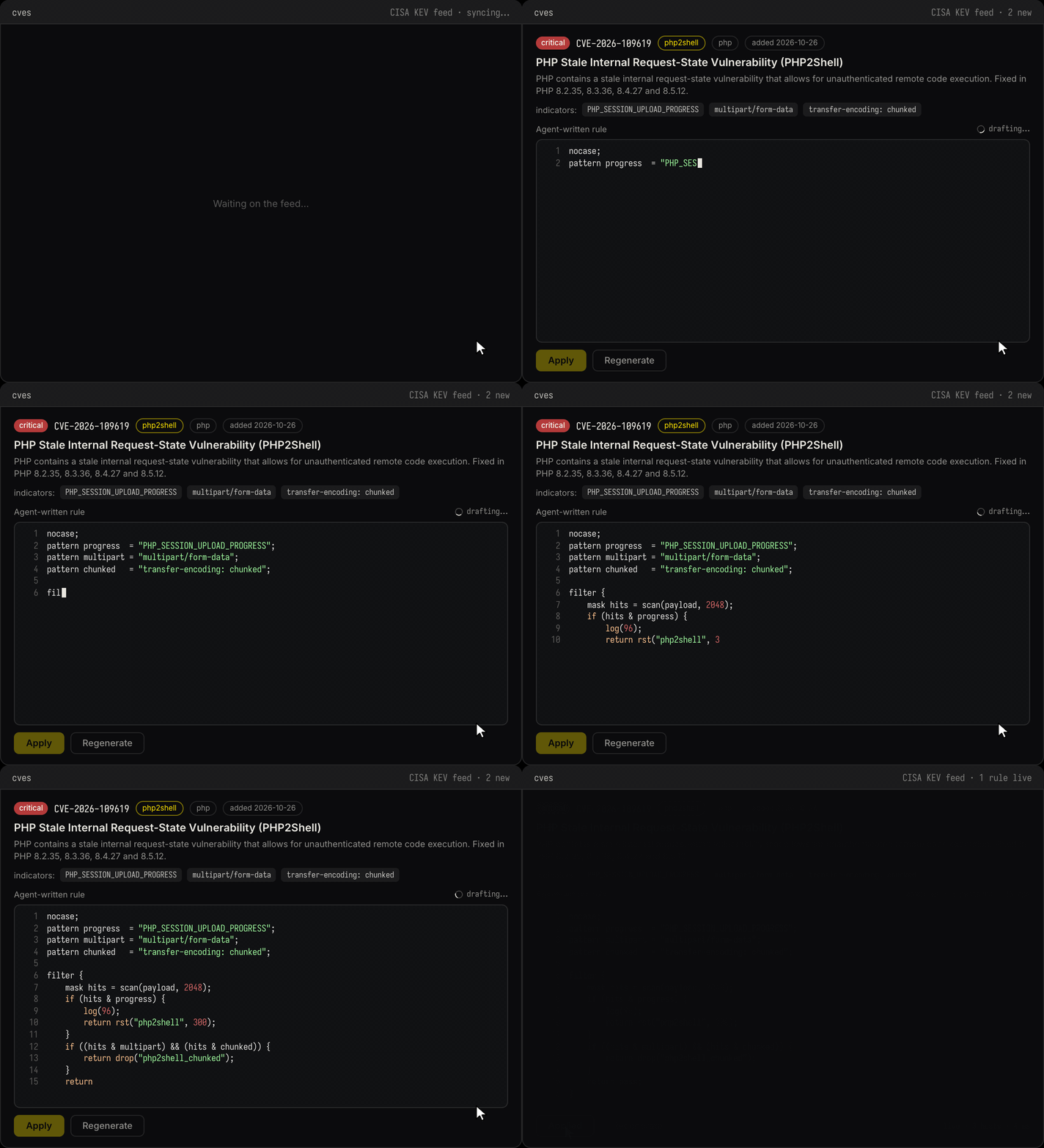
minutes
Mean Time to Mitigate
Every new RCE is now a contest of agent speed.
3 to 6 ms
rule to live
Policy is applied without restarts or redeploys, measured in our lab.
per host
enforcement
This host-based IPS bridges your NGFW patch gap immediately.
which react versions are affected, and which fix it?
react 19.0, 19.1 and 19.2 were affected, and react fixed all three on 3 december 2025. install the current release of your line, not the first fix: it also closes CVE-2026-126187, the second remote code execution bug in the same code. the version numbers are those of the react-server-dom-webpack, react-server-dom-turbopack and react-server-dom-parcel packages. an app that never runs react on a server is not affected, whatever its react version. next.js and the other frameworks that bundle this code are covered below the tables.
| branch | vulnerable | first fixed | install now |
|---|---|---|---|
| react 19.3 | vulnerablenone | first fixednever affected | install now19.3.1 |
| react 19.2 | vulnerable19.2.0 | first fixed19.2.1 | install now19.2.9 |
| react 19.1 | vulnerable19.1.0 and 19.1.1 | first fixed19.1.2 | install now19.1.10 |
| react 19.0 | vulnerable19.0.0 | first fixed19.0.1 | install now19.0.9 |
react 19.3: 19.3.0 is affected by CVE-2026-126187 only. 19.3.1 is the release npm tags as latest.
react 19.0: react-server-dom-parcel has no 19.0 releases. it starts at 19.1.0.
distribution packages
there are no distribution packages to track for React2Shell. the affected code ships as npm packages, not as part of an operating system, and the distributions say so: debian marks CVE-2025-55182 not-for-us, ubuntu says it does not apply to software in ubuntu, and red hat lists its products as not affected. the version in your lockfile always moves with the fix, so there is no backport case to check.
next.js and other frameworks
next.js bundles its own copy of react inside the next package, so the react versions above may not show in a next.js project at all. app router apps on next.js 15.0.0 through 16.0.6 are vulnerable, as are canary releases from 14.3.0-canary.77. the first fixed releases are 15.0.5, 15.1.9, 15.2.6, 15.3.6, 15.4.8, 15.5.7 and 16.0.7 (next.js advisory). install 16.4.6, the release npm tags as latest, or 15.5.29 on next.js 15, which gets security releases through 31 january 2027 (support policy). on a 14.3 canary, go back to stable 14. react's advisory also names react-router (its unstable RSC APIs), waku, @parcel/rsc, @vitejs/plugin-rsc and rwsdk as affected, and sends expo users to expo's own changelog. for those, react's instructions are to install the latest release of the framework package and of the react-server-dom-* package it uses; for rwsdk, 1.0.0-alpha.0 or later.
how do I check whether my app is patched?
check what the project resolved, not what package.json asks for. on next.js the vulnerable react code is inside the next package, so the react package names can be missing while the app is still vulnerable. we have not run these commands ourselves; each comes from the source it links.
list the resolved versions
the definitive check. compare what it prints with the table above: react-server-dom-* at 19.0.9, 19.1.10, 19.2.9 or 19.3.1 is current, and 19.0.1, 19.1.2 or 19.2.1 is the minimum that closes React2Shell. a next.js app can print nothing for the react-server-dom-* names, because next.js bundles them; read the next line instead. for a deployment you cannot get a shell on, vercel suggests loading a page and running next.version in the browser console.
run the next.js checker
vercel's tool for next.js and react server components projects. it scans every package.json, monorepos included, for next and the three react-server-dom-* packages. --dry-run only reports; without it the tool offers to bump versions and refresh the lockfile. its checks stop at the 11 december 2025 fixes (next.js 15.0.7 through 16.0.10 and 14.2.35, react 19.0.2, 19.1.3 and 19.2.2), so a pass means React2Shell is closed, not that you are on the release to install today.
ask npm whether a version is flagged
react deprecated the affected releases on npm, so the registry answers for one exact version. put your own version in place of 19.2.0. the releases vulnerable to React2Shell carry the first notice below, and 19.0.1 through 19.0.5, 19.1.2 through 19.1.6 and 19.2.1 through 19.2.5 carry the second, for the bugs found later. either notice means upgrade. no output does not mean current: 19.0.6 through 19.0.8, 19.1.7 through 19.1.9, 19.2.6 through 19.2.8 and 19.3.0 carry no notice and are affected by CVE-2026-126187.
- React2Shell
Critical Security Vulnerability in React Server Components - later bugs
High Security Vulnerability in React Server Components - no notice
no output
the patch
one commit on react's main branch fixes React2Shell: 9 files, 712 lines added and 278 removed, with no test files. react released it the same day as v19.0.1, v19.1.2 and v19.2.1. the commit message describes a refactor that brings the server's reply decoder in line with the client's, and ends "This also fixes a critical security vulnerability." the excerpts below are copied from that commit.
the fix is an own-property check. wherever the decoder follows a key that came from the request, it now asks hasOwnProperty first. a reference that names something the object does not itself hold, such as __proto__ or constructor, is not followed, so the walk can no longer leave the object for its prototype chain. the same check goes into each bundler's requireModule, which looks up a module export by name.
the rest of the commit rewrites ReactFlightReplyServer.js (596 lines added, 226 removed) and hardens multipart parsing: an error while resolving a field or a file now destroys the busboy stream, where it used to be thrown.
CVE-2025-55182+596 −226 in this file
the reference walk. the old code read value[path[i]] for every key in a $id:key:key reference, which follows the prototype chain. the new code takes a step only when the key is the value's own property. the guard is added in both places the walk happens, fulfillReference and getOutlinedModel.
CVE-2025-55182+6 −1 in this file
the parcel build's requireModule. an export name that is not the module's own property now returns undefined. the webpack and turbopack builds get the same four lines, and this is the change datadog quotes.
what changes for you after the upgrade
- a request whose reference names a property that does not exist no longer ends in HTTP 500; the reference is ignored. searchlight cyber uses that difference to tell patched servers from unpatched ones. no breaking change for legitimate server functions is documented.
how do I detect React2Shell attempts?
the indicators below are the ones AWS, datadog, elastic, searchlight cyber and opensourcemalware publish. none is proof on its own. the action header is how any server function call is routed, so match it together with the body markers, and expect attackers to reshape the request: React2STEAL tries seven variants in turn.
in requests
a POST with a
next-actionorrsc-action-idheader whose body contains"status":"resolved_model"and$@. these are AWS's network indicators, and its custom WAF rule matches on exactly these four things.the header alone also arrives on legitimate server function calls. AWS's rule fires only when all four match.
the same request reshaped to get past a rule. opensourcemalware found these in React2STEAL's code:
Transfer-Encoding: chunkedwith noContent-Length, padding in front of the multipart body, a random multipart boundary, a malformedContent-Typevalue, andx-action-idsent alongsideNext-Action.the two header lines above are React2STEAL's plain form. one of its variants randomizes the boundary.
for React2STEAL, the
x-middleware-subrequestheader on an incoming request, and/_next/image?url=requests that point at the cloud metadata address169.254.169.254(opensourcemalware).these are the campaign's two other routes, not React2Shell. a server that received them needs its secrets rotated.
in logs
HTTP 500 or 303 responses to those POSTs whose body contains
E{"digest"(elastic); a 500 withE{"digest"is searchlight cyber's sign of an unpatched host.runs of 500 or 502 on server function routes, and stack traces that name
Flightorreact-server-dom-*, are weaker signs of the same thing.
on the host
a shell or downloader such as
sh,bash,curlorwgetstarted by the node.js process. datadog's workload protection rule keys on this: the parent isnodeand the child is a shell,curlorwget.this is evidence the attack already worked. the host needs incident response, not a filter.
reconnaissance commands (
whoami,id,uname), reads of/etc/passwdand unexpected files in/tmp(AWS). for React2STEAL, calls to AI provider APIs from your web server with a desktop chrome 126 user agent, which is the campaign testing stolen keys from your own machine (opensourcemalware).
public detection rules
| rule set | rules | source |
|---|---|---|
| cloudflare managed ruleset | rules33aa8a8a948b48b28d40450c5fb92fba (React - RCE - CVE-2025-55182) | sourcecloudflare |
| cloudflare free ruleset | rules2b5d06e34a814a889bee9a0699702280 | sourcecloudflare |
| cloudflare, 10 dec 2025 release | rulessecond React2Shell rules ending 15fce168 (managed) and 74746aff (free) | sourcecloudflare changelog |
| AWS WAF | rulesAWSManagedRulesKnownBadInputsRuleSet 1.24 or higher; custom rule ReactJSRCE_CUSTOM | sourceAWS bulletin |
| elastic security | rulesReact2Shell (CVE-2025-55182) Exploitation Attempt; React2Shell Network Security Alert | sourceelastic |
| datadog | rulesworkload protection agent rule; indicator list react-CVE-2025-55182 | sourcedatadog |
| assetnote (searchlight cyber) | rulesreact2shell-scanner | sourceassetnote |
what can I do if I can't upgrade react yet?
only the upgrade is complete. vercel calls it "the only complete fix", and react says of the temporary mitigations hosting providers applied: "You should not depend on these to secure your app, and still update immediately." each stopgap below narrows the exposure and leaves the bug in place.
| stopgap | closes | leaves open |
|---|---|---|
| turn on your edge WAF's React2Shell rule (cloudflare, AWS WAF, vercel, akamai, fastly)per vercel | closesknown request shapes that cross the edge | leaves openrequests that reach the origin directly, traffic between your own services, and reshaped requests: vercel says WAF rules "cannot guarantee protection against all possible variants of an attack" |
| put authentication in front of every deployment that is not production (on vercel, standard protection)per vercel bulletin | closesolder and preview deployments that still run a vulnerable build after production is patched | leaves openthe production domain |
| block outbound HTTP from app servers to bare IP addresses on ports other than 80per AWS | closesa common second stage, where the exploited process fetches a payload | leaves openthe code execution itself |
strip or reject the x-middleware-subrequest header at your proxy, and enforce IMDSv2per opensourcemalware | closesthe two other routes React2STEAL tries: the next.js middleware bypass CVE-2025-29927 and the /_next/image request to cloud instance metadata | leaves openReact2Shell itself |
React2Shell questions
is react 19.2.0 vulnerable to React2Shell?
yes. the react-server-dom-webpack, react-server-dom-turbopack and react-server-dom-parcel packages at 19.0.0, 19.1.0, 19.1.1 and 19.2.0 are vulnerable (react advisory). 19.2.1 is the first fixed release on that line. install 19.2.9, which also fixes the second remote code execution bug, CVE-2026-126187.
which versions fix CVE-2025-55182?
react 19.0.1, 19.1.2 and 19.2.1, released on 3 december 2025, and next.js 15.0.5, 15.1.9, 15.2.6, 15.3.6, 15.4.8, 15.5.7 and 16.0.7 (next.js advisory). those close React2Shell and nothing later. the versions to install now are react 19.0.9, 19.1.10, 19.2.9 or 19.3.1, and next.js 16.4.6 or 15.5.29.
is next.js 15 affected by React2Shell?
yes, when the app uses the app router. next.js 15.0.0 through 16.0.6 are affected, and so are canary releases from 14.3.0-canary.77. next.js says "Next.js 13.x, Next.js 14.x stable, Pages Router applications, and the Edge Runtime are not affected." next.js bundles react, so upgrade next itself: 15.5.29 on next.js 15, or 16.4.6. the later denial-of-service bugs do reach next.js 13.3 and later and 14.x, and are fixed in 14.2.35.
does React2Shell affect my app if I don't use server functions?
yes, if the app supports react server components at all. react's advisory says "Even if your app does not implement any React Server Function endpoints it may still be vulnerable if your app supports React Server Components." an app whose react code never runs on a server is not affected.
what is CVE-2025-66478, and why was it rejected?
it was the next.js number for the same bug. next.js bundles react inside the next package, so dependency tools that look for the react packages did not flag next.js apps, and a second CVE was issued to make them visible (react2shell.com). its CNA, github, rejected it on 3 december 2025 as a duplicate of CVE-2025-55182. advisories and scanners still use it, and CISA's catalog entry notes the link.
what is CVE-2026-126187? is it the same as React2Shell?
no. it is a second remote code execution bug in the same react-server-dom-* packages, published on 10 november 2026 and scored CVSS 4.0 9.5 in its advisory. the advisory says it "only affects extremely rare cases where responses transport multiple typed arrays and an attacker-controlled value". every earlier release that fixed React2Shell is affected by it. it is fixed in 19.0.9, 19.1.10, 19.2.9 and 19.3.1. a next.js advisory published on 22 october describes a typed-array RCE fixed in next 16.4.1; it names no CVE and does not reference react's advisory, so it is likely, not confirmed, to be the same bug.
how do I know if I am patched for React2Shell?
run npm ls react-server-dom-webpack react-server-dom-turbopack react-server-dom-parcel next in the project and compare the result with the fixed versions. on next.js the react package names can be missing because they are bundled, so read the next version, or run npx fix-react2shell-next --dry-run (vercel's checker). a deployed site reports its version when you run next.version in the browser console. we have not run these commands ourselves.
is there a public exploit for React2Shell?
yes. datadog dates the first working proof of concept to 4 december 2025 and reproduced code execution on a blank create-next-app project. the reporter published the original proof-of-concept code on 5 december. it takes one request and no login, and CISA lists the bug as exploited.
can a WAF or a network rule block React2Shell without upgrading?
partly. a rule on the request path stops the request shapes it knows, for the traffic that passes through it. an edge WAF does not see requests that reach your origin directly or traffic between your own services, and a rule on the host cannot read requests that arrive still encrypted. neither stops a reshaped request it has no pattern for: React2STEAL tries seven variants in turn (opensourcemalware), and vercel says WAF rules "cannot guarantee protection against all possible variants of an attack". keep the rule on and upgrade.
what is React2STEAL, and do I need to rotate my secrets?
React2STEAL is a campaign, not a bug. opensourcemalware reported it on 18 november 2026: hijacked github accounts run github actions workflows that scan for next.js servers, exploit React2Shell and the next.js middleware bypass CVE-2025-29927, and commit stolen environment variables, .env files, cloud credentials and AI provider keys to public repositories. both bugs have fixes. if your app was online and unpatched, rotate every secret its process could read after you patch.
sources
from the react and next.js teams
- react: critical security vulnerability in react server componentsthe maintainer advisory, 3 dec 2025
- react security advisory: react server components are vulnerable to RCEGHSA-fv66-9v8q-g76r, affected and fixed package versions
- meta: CVE-2025-55182the CNA's own record
- facebook/react: patch FlightReplyServer with fixes from ReactFlightClientthe fix commit
- facebook/react: pull request 35277the pull request the fix was merged from
- next.js: security advisory, CVE-2025-66478affected and fixed next.js versions
- next.js security advisory: next.js is vulnerable to RCE in react flight protocolGHSA-9qr9-h5gf-34mp
- react: denial of service and source code exposure in react server componentsthe follow-on bugs, 11 dec 2025, updated 26 jan 2026
- next.js: security update, 11 dec 2025next.js fixes for the follow-on bugs, including 14.2.35
- react security advisory: unauthenticated remote code execution in react server componentsCVE-2026-126187, the second RCE, 10 nov 2026
- next.js security advisory: remote code execution in use cache functions returning typed arrayslikely the next.js side of the second RCE; names no CVE
- next.js: support policywhich next.js lines still get security releases
government and CERT
- CISA known exploited vulnerabilities catalogadded 5 dec 2025, ransomware use known
- NVD: CVE-2025-55182CVSS 3.1 10.0 as scored by meta, CWE-502, CISA's SSVC
- CVE record: CVE-2025-66478rejected as a duplicate of CVE-2025-55182
researchers
- react2shell.comthe reporter's own account
- searchlight cyber: high fidelity detection mechanism for RSC and next.js RCEroot cause and the patched-or-not difference
- assetnote: react2shell-scanneropen-source detection tool
- datadog security labs: CVE-2025-55182 (React2Shell)reproduction, observed attacks, host rule
- datadog: indicators of compromiseIP addresses seen sending exploit payloads
- opensourcemalware: React2STEAL uses github actions to exploit React2Shellthe React2STEAL campaign, 18 nov 2026
vendors and distributions
- AWS: china-nexus cyber threat groups rapidly exploit React2Shellfirst attempts, indicators, network firewall rule
- AWS security bulletin AWS-2025-030managed and custom WAF rules
- cloudflare: WAF rules for the react vulnerabilityrule ids and deployment time
- cloudflare: WAF release, 10 dec 2025second React2Shell rules
- vercel: React2Shell security bulletinrequired action, deployment protection, WAF limits
- vercel-labs: fix-react2shell-nextversion checker and fixer for next.js projects
- darktrace: how opportunist attackers exploited CVE-2025-55182 within hourshoneypot timing
- elastic: React2Shell (CVE-2025-55182) exploitation attemptdetection rule
- chainguard: React2STEAL, what it is and what to checkReact2STEAL corroboration, 18 nov 2026
- gitguardian: React2STEALReact2STEAL corroboration, 20 nov 2026
- vite-plugin-react security advisory GHSA-fmh4-wr37-44fpthe @vitejs/plugin-rsc advisory, listed from the next.js advisory's references and not read for this page
changelog and credits
- page published. facts checked against react's and next.js's advisories, the fix commit, the npm registry, NVD, the debian, ubuntu and red hat trackers, FIRST EPSS for 25 nov 2026 and CISA KEV catalog 2026.11.25.
found and reported by Lachlan Davidson through meta's bug bounty on 29 november 2025. react's advisory: "Thank you to Lachlan Davidson for discovering, reporting, and working to help fix this vulnerability." the fix was written and merged by Sebastian Markbåge, and its commit lists no co-authors.
this page is maintained by yeet, which makes the yeet programmable firewall. we are not affiliated with react, meta, vercel or the researchers. tell us if something here is wrong.
see the yeet programmable firewall on your own hosts
30 minutes with an engineer who builds yeet. we check where your TLS ends and which kernel you run, and work through a rule for React2Shell with you.